An office is one of the hardest places we ask a plant to live. The light is a fraction of what it looks like, the air is cold and dry, and there is always a kind colleague with a water bottle. Some plants cope with all of that for years. Others never will, however much you like them.
Your office is darker than you think
Our eyes are very good at adjusting, so a bright office and a shaded garden feel much the same. To a plant they are nothing alike.
Light is measured in lux. Outdoors in Malaysia, open shade on an ordinary day runs to 10,000 lux or more, and direct sun is several times that. Standard office lighting is designed to put roughly 300 to 500 lux on the desk. Plants sold as "low light" will hold on from a few hundred lux, and they only grow properly from around 1,000 upwards.
So the middle of an open-plan floor sits at the very bottom of what even the toughest plants can live on. Right beside a window it is often several thousand lux. But light falls away fast. Two or three metres in from the glass, most of it is gone, and tinted glass and blinds take a share before it arrives.
A free light-meter app on a phone is not precise, but it is good enough to compare one spot with another. Measure at midday, where the leaves would be. Then sort your floor into three zones.
- Within a metre or so of a window. The good seats. Nearly everything on the list below will grow here. Watch for direct afternoon sun through west-facing glass, which can scorch leaves that were raised in shade.
- The middle of the floor, under ceiling lights. Survival light. Choose only from the toughest plants and expect them to hold steady, not grow.
- Corridors, windowless meeting rooms, the corner by the photocopier. Nothing lives here for long. Plants in these spots need to be rotated out regularly, or the spot needs a grow light.
Cold, dry, and then warm all weekend
Air-conditioning takes moisture out of the air. The thin-leaved plants of the forest floor feel it first, as brown, crisp edges. The worst position is directly under or in front of a vent, where a stream of cold air runs over the leaves all day. Aglaonema in particular dislikes it. It is a plant of the warm Southeast Asian forest floor, and cold draughts leave dark, greasy-looking patches on the leaves.
Then on Friday evening the air-con goes off and the floor sits warm and still until Monday. Plants put up with that swing better than people expect, provided their roots are healthy. The roots are where offices go wrong.
The colleague with the watering can
In low light and cool air a plant grows slowly and drinks very little. The pot stays wet far longer than the same pot would outdoors. Meanwhile three different people, all meaning well, tip the rest of their water bottle into it on their way past. The roots sit in cold, wet mix with no air, and they rot. The leaves yellow and droop. Drooping looks like thirst, so someone waters it again.
Most office plants are lost this way. Very few die of neglect.
Plants that cope
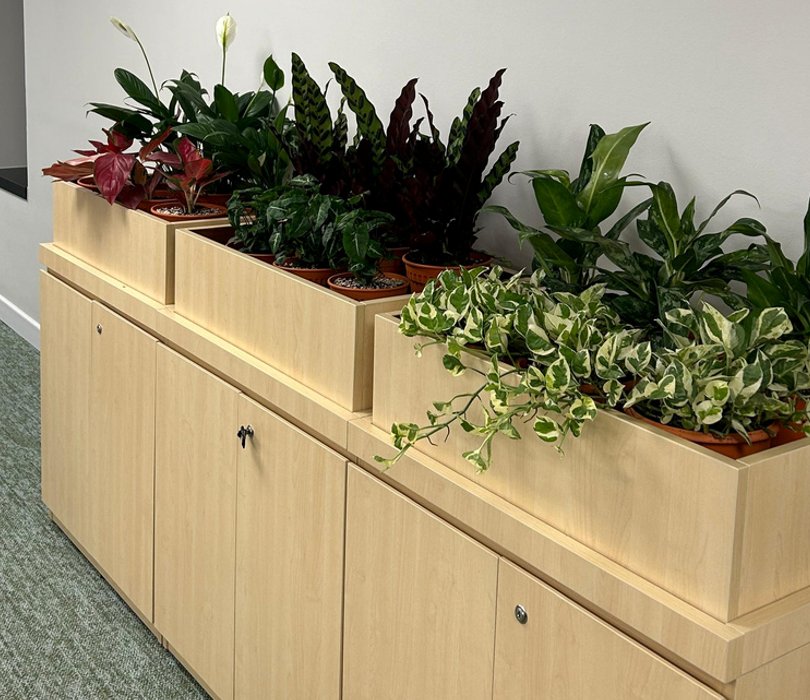
| Plant | Where it works | Worth knowing |
|---|---|---|
| ZZ plant (Zamioculcas zamiifolia) | Mid-floor and darker corners | Stores water in fat underground rhizomes. Almost always killed by overwatering. |
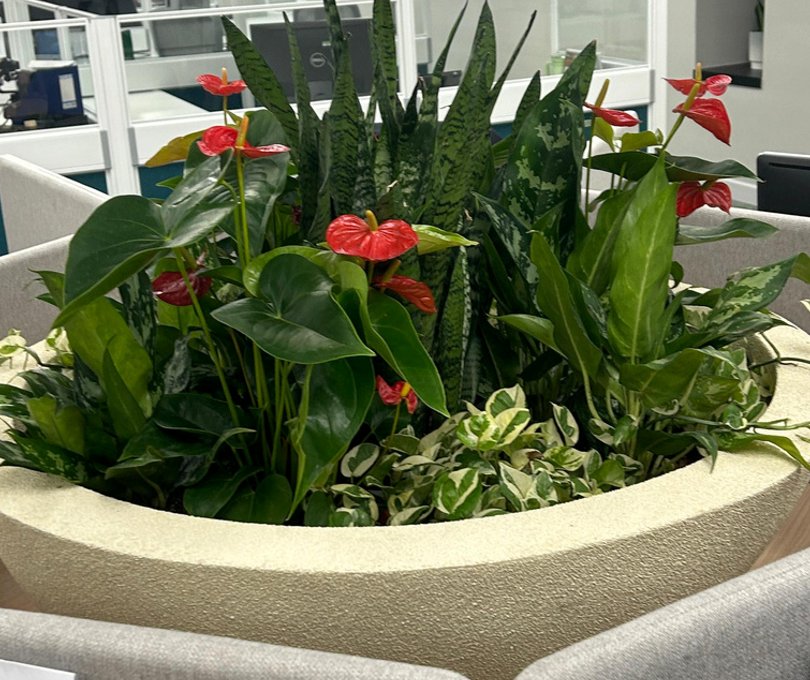
| Snake plant (Sansevieria, Dracaena trifasciata) | Anywhere from a dim corner to a sunny window | Upright, so it suits narrow spaces. Let it dry right out between waterings. |
| Pothos, or money plant (Epipremnum aureum) | Cabinet tops, shelves, mid-floor | Very forgiving. Variegated kinds turn greener in low light. Trim the trails to keep it full. |
| Aglaonema | Mid-floor, away from vents | Plain green and silver kinds take lower light than the red and pink ones. |
| Dracaena (D. fragrans and its varieties) | Floor plants for corners with some window light | Slow and steady. Gives height without needing the light a fig needs. |
| Lady palm (Rhapis excelsa) | Lobbies and reception areas with reasonable light | One of the few palms that really tolerates indoor light. Slow-growing, so a big one costs more. |
| Peace lily (Spathiphyllum) | Near windows, out of direct sun | See the caveats below. |
The peace lily needs a caveat or two. It is thirstier than everything else on this list, so it breaks the watering routine. It collapses dramatically when dry and recovers within hours of a drink, which trains people to overwater everything around it. In low light it stays green but rarely flowers. In very dry air the leaf tips brown. We use it, but near a window and in the care of one person.
Plants that will sulk
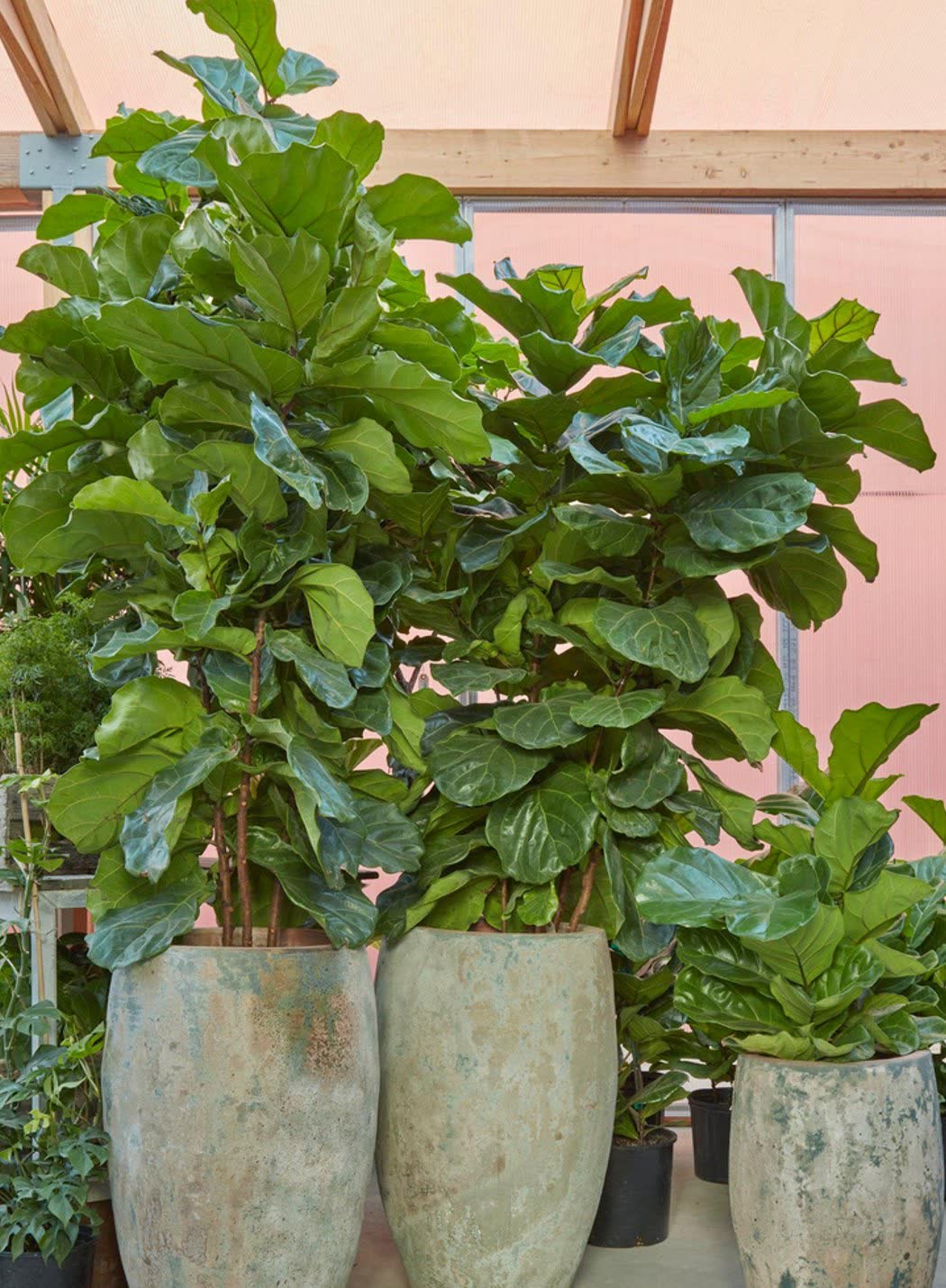
- Fiddle-leaf fig, away from a window. We like a big fiddle-leaf and we use them. But it is a tree that wants bright light. Beside a large window it can do very well. Five metres in, it drops its lower leaves one at a time until you are left with a stick.
- Calathea. Beautiful, and a plant of humid forest shade. In air-con the leaf edges crisp and curl within weeks.
- Most ferns. Boston fern sheds all over the carpet and maidenhair simply gives up. Bird's nest fern is the one that sometimes manages, in good light and away from the vents.
- Succulents and cacti. They look like ideal desk plants because they need so little water. But they are sun plants. At office light levels they stretch, go pale and slowly starve.
- Herbs. Basil, mint and the rest want hours of direct sun. A pantry windowsill very rarely offers that.
One watering rule for the whole office
Push a finger into the mix up to the second knuckle. If it feels damp, walk away. If it feels dry, water slowly until a little runs out of the bottom of the pot, and tip away anything still standing in the saucer or outer pot after half an hour.
Two things make it work. Give the job to one named person, with one stand-in for when they are on leave, and tell everyone else, kindly, to stop. And forget the calendar. "Every Monday" takes no account of how dim the corner is or how slowly the plant is drinking. The finger does. For a ZZ or a snake plant in a dim spot, the answer may be "not yet" for three or four weeks.
Wipe the leaves with a damp cloth now and then as well. Dust blocks light, and there is none to spare.
Rest and rotation
In survival light a plant is living on its savings. It will look fine for months and then start to thin. The answer is to take it out before that happens, give it a spell in proper bright shade to rebuild, and put a fresh one in its place.
This is most of the reason plant rental exists. An office can buy its own plants, and with good windows and one careful person that works well. But most offices have nowhere to rest a tired plant and nobody whose job it is. With rental, the plants stay ours. We choose them for the light you really have, come back on a regular round to water, clean, feed and trim, and swap a plant that is struggling.
A word about air purification
You will often read that office plants clean the air, usually with a mention of a 1989 NASA study. That study was real, but it was done in small sealed chambers. Later reviews of the research worked out that an ordinary building, with ordinary ventilation, would need somewhere between ten and a thousand plants on every square metre of floor to make a comparable difference. So we do not sell plants as air filters.
We supply them because people like working near something alive. A healthy plant in reception says something about how a place is run. So does a dying one.
If you would like plants chosen and placed for the light your office really has, see our indoor plants and office greenery service. If you look after a whole building, start at For Business.